By Ray Thursby
European Car, July 1998, PG. 8
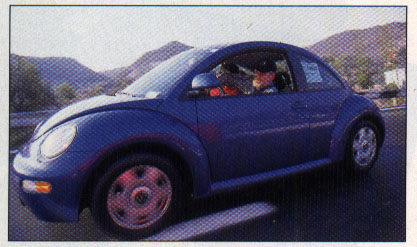
 A message to the purchaser of the light-blue New Beetle carrying a VIN ending in 15986: Your shiny new toy was personally tested on the roads around Puebla, Mexico, prior to its arrival at your local VW showroom by the ace european car team of James Sly and this writer. I don't know whether this should be a cause for celebration--this is, after all, now a car with " A History" (of sorts)--or for alarm (for obvious reasons), but I thought that you should know.
Puebla is not my idea of the ideal vacation destination. Close enough to Mexico City to be blanketed by the capital's infamous smog--as bad as anything I remember from growing up in 1950's Los Angeles--and possessed of the beauty and decay, the riches and terrible poverty that exist side by side throughout Mexico, it is a town where a three-day visit seems enough.
But it also is where Volkswagen Beetles are built, and thus an appropriate place to go when trying to assess the New Beetle's niche in the automotive world. In the middle of an arid Mexican plateau, away from the hype and glamour attendant upon its U.S. introduction, the reincarnation of a classic and much-loved design has to stand on its own merits, and must face direct comparison with its ancestor, examples of which fill the streets of Puebla. As well they should, for VW's Mexican factory still turns out Old Beetles at the rate of some 150 per day, in addition to New Beetles Jettas and Golf Cabrios for domestic and import markets.
This is a situation unique to VW: Imagine Ford, for example, building Model T's and Tauruses in adjacent buildings. The contrast between "Very Old" and "Very New" was a strange element in what turned out to be a deeply weird trip. I feel compelled to draw a veil of merciful secrecy over the more bizarre twists and turns, consumption of exotic beverages and harrowing bus rides of our stay south of the border. What the heck, you folks are only interested in cars, right?
First, the Old Beetle. Although modernized in many ways, including fitment of inyeccion multiple (using a throttle body that looks amazingly like a one-barrel Solex carburetor) and catalizador tres vias to the 44-bhp engine, and of course frenos discos in front, it remains the simple, clever and in some respects crude machine of fond memory. Neither the car itself or the labor-intensive assembly line on which it is built would hold any surprises for anyone who saw it 50 years ago. Currently available in two forms--plain Clasico and plainer City--its primary attractions are bullet proof mechanicals and a price low enough (in the $8,000 range) to undercut any other new car available in Mexico. Given those attributes, its future seems assured.
We, of course, can't buy a new Old Beetle (legally anyway) but are encouraged, if so inclined, to sign on the dotted line for a New Beetle. I, for one, find its attractions, beyond the enormous amount of publicity its gestation and introduction have generated for VW, rather harder to define.
Let it be said right away that the New Beetles underpinnings are virtually beyond reproach. The fourth-generation Golf platform is a vast improvement on what was already one of the best front-drive chassis available. Ride, handling and refinement all rate superlatives; even when supplied with the basic eight-valve engine, the Golf IV will be sure to please when it arrives here later this year.
Now comes the difficult part. I would be tempted to brand the New Beetle nothing more than a Lava Lamp on four wheels, except that the car is less faithful to its original design that is the reincarnated decorative light. To me, it seems a clever toy, a momentary attention-gutter of only short-term interest. Harsh words? Consider the following questions used to make this assessment:
Is the New Beetle a groundbreaking design? The original was, of course. It stood out from the mainstream shapes common it its day, making do without excessive chrome trim and other needless ornamentation. Looking like nothing else on the road, it could be picked out of a crowded parking lot even by people who knew little a bout cars. And at a time when aerodynamics were paid little attention, Dr. Porsche's design was an early mass-production attempt to improve both performance and fuel economy by presenting a smaller and smoother face to the wind.
In contrast, the new version is distinctive, but entirely derivative, depending on nostalgia for its appeal. It is no doubt wind tunnel-friendly as well, but so are a horde of other cars. Personally, I don't think that the design comes off all that well when seen on the road, lacking the balance between masses (front, cabin and rear) characteristic of the original. Cute perhaps, in a roly-poly way, but destines in my view to wear out its welcome in a short time.
Is the New Beetle a functional design? No. Its body shape exists for one purpose only: Marketing. It is not easy to look at a reskinned two-door Golf and find any other compelling reason for its existence. And then there's packaging efficiency, one of the originals strengths. Hardly a millimeter-square area can be found in a 1948--or '68 or '98--Beetle that was not used for something. The New Beetle contains more wasted space than equivalent Golf, particularly the interior. A prime example is the huge panel separating the dashboard and windshield; senor Sly and I felt installation of a diorama (I suggested something along the lines of Disneyland's "Great Moments With Mr. Lincoln," while James opted for the less exciting but more educational "How a Bill Becomes a Law") might relieve the monotony and give that expanse of plastic a purpose.
Is the New Beetle faithful to the original? Hardly. Though space exists for a rear mounted engine--and I'd be sorely tempted to chuck a Porsche powerplant in a New Beetle's bustle, just for laughs--the newcomer, like the vast majority of cars on the road today has its motive power up front. Conceptually, it reminds me of some of the cheesier fiberglass kit cars which purported to replicate Bugattis and SSK Mercedes-Benzes while being based on VW Beetle chassis pans. Which brings us to another major difference between old and new: Anyone tiring of the Old Beetle's looks could transform it into a sports car by replacing the sheet metal with a plastic body. Alterations to the New Beetle will consist mainly of sills, flares, spoilers and wings, many of which are sure to enhance individuality at the expense of good taste.
In a word, the New Beetle is a fake. it's a way for the company--and buyers--to revisit the past without suffering the inconveniences and depravations a realistic rebirth of the original would necessarily include. It seems to have been created with the same mindset many people adopt when buying a classic home: That charming little Cape Cod is just what they want, but wouldn't it be nicer if remodeled to include a modern kitchen and bathrooms? Drywall is so much easier to deal with than nasty old plaster, and where are we going to put the media room?
My view: If you want to go back in time , buy an Old Beetle and restore it.
Being a realist, I'm prepared to be trampled in the rush of customers flocking to buy New Beetles as fast as they come off the trucks. I expect it to be a rousing success. For a couple of years, anyway. But the initial furor will die out--sustained, for a time, by the TDI, 1.8 turbo, VR6 (VW says no, I say yes) and cabriolet variations. But the New Beetle leads Volkswagen down a tricky path; like the original, the new car will be difficult, if not impossible, to update. As will be necessary.
If retro-mania is to become a fixture at VW, may I suggest a revival of interest in the minivan? Once upon a time, the people-mover market was VW's playground; Microbuses and later Vanagons were dominant in this lucrative area, even if the final Eurovan, underpowered and overpriced, was a flop in the U.S. Remedies for all of the Eurovan's shortcomings exist, and are applied to the Caravelle version which sells well in Europe.
But looking ahead is ultimately more important than dwelling on the past. Golfs, Jettas, Passats and future additions to the lineup must have far more to do with VW's long-term survival than a warmed-over KDF-Wagen. Any company that places its bets on a car being judged primarily as an icon is taking a terrible risk.